



![Indian Institute of Technology [IIT], Delhi](https://blogs.lawships.in/wp-content/uploads/2020/05/download.jpeg "JOB POST: Professors at Indian Institute of Technology [IIT], Delhi: Applications Open")


 Interview of Anita Ninan, LLM (UGA), a dual licensed attorney admitted to practice in the State of Georgia and a certified lawyer admitted to practice in India.
Prior to her practice in the U.S with two top tier firms, she worked as a Legal Counsel at Standard Chartered Bank (Mumbai and Delhi).
Ms. Ninan currently serves as the President of the Georgia Indo-American Chamber of Commerce (GIACC).
She also serves as an Honorary Legal Advisor to the Indian Consulate General of Atlanta.
She is a member of the Advisory Council, Dean Rusk International Law Center, University of Georgia School of Law.
Please introduce yourself to our readers.
Hello, My name is Anita Ninan and I am a US immigration attorney.
I am a dual licensed attorney admitted to practice in the State of Georgia and a certified lawyer admitted to practice in India. With well over a decade of legal experience across 2 continents, I focus my practice on corporate and business immigration law.
I advise corporate clients and foreign nationals regarding all aspects of employment-based U.S. immigration law across a range of industries.
Tell us about your school and college life? What interested you, and who all were your inspiration then?
I am a graduate of St. Stephen’s College, Delhi University, where I completed my Bachelor’s degree in Economics (Honors). After that, my choices were to consider the Indian Civil Service, do an MBA, or pursue law.
My mother, who was an eminent legal professional and the Director of the Indian Law Institute at that time, Dr. (Mrs.) Alice Jacob encouraged me to consider law.
Several of her eminent colleagues and peers, like Professor Upendra Baxi, Professor Lotika Sarkar and Professor Ponnuswami, were Professors at the Campus Law Faculty at that time. So I decided to pursue my LLB at Campus Law Faculty, Delhi University.
You completed your LLM from UGA back in 1990. How was your experience? How has it shaped your life?
When I decided to do an LLM in the US, I received admission in the Schools of Law at Northwestern University in Chicago and Duke University in North Carolina. However, they were not able to offer me financial aid that year.
Instead, the University of Georgia School of Law, Athens, Georgia, offered me financial aid. Dr. Gabriel Wilner, Director of the Graduate Legal Studies (LL.M. program) had visited the Indian Law Institute, at that time and shared about the LL.M. program.
An added attraction was that my husband was working in Atlanta, which is only an hour or so away from Athens, Georgia. I enjoyed the experience and the rigour of the program. I met international attorneys from several countries in the LL.M. program – Germany, France, South Korea, Israel…
I had the good fortune to return to the US several years later, and the Law School reached out to me as an Alumni to serve on the Alumni Advisory Council of the Dean Rusk International Law Center.
This has enabled me to contribute to the programs of the Center as much as I have benefited professionally from the association.
For the last two years I have been invited to present a discussion on the OPT (Optional Practical Training) Process available to the LLM class upon graduation – to avail of the benefits of a 12-month practical training in the US allowed as per current US immigration law.
In that presentation, I also cover the limited work opportunities available to LL.M. graduates upon completion. I also have organized a visit of the Indian Consul General, Atlanta to speak at the Law School on Indo-US Bilateral relations, later this month, as part of the Rusk Center’s “Consular Series”.
What makes legal education in the US different from that in India?
Let’s speak about the similarities first. The underlying framework of both legal systems is English common law or case law.
This makes the transition for Indian students from the Indian LLB program to the US LLM program much smoother than for students coming from civil law countries, in terms of understanding the role of precedent case law in determining the governing law.

The rigour of the curriculum and research (since I submitted an LLM Thesis, in addition to core courses) in the LL.M. program stood out for me, in comparison to my LL.B. program.
That said, I know the National Law Schools in India that were established after my time, have a great reputation for producing very competitive and world-class lawyers.
How does the ‘work’ and ‘work-life’ in the US compare that within India?
I have been privileged to work in medium and large size law firms. I believe this is challenging and at times stressful dealing with clients’ expectations, similar to large law firms in India.
This is more so in a specialty field like US immigration law, when the work authorization and immigration status of foreign nationals hangs in the balance pending petition and application approvals by the US citizenship and immigration services.
Nevertheless, working in big well-established law firms gives you tremendous opportunities to network, develop your client base, and partner with other community organizations and obtain recognition in the business community.
I worked as in-house Counsel with Standard Chartered Bank in Mumbai and Delhi, when I was in India. That was a different experience.
You are licensed to practice in the US. What’s the process like for a young lawyer from India to get her/himself qualified as a US attorney?
When I did my LL.M. program in the US, foreign attorneys like me could only sit for the New York, California and Texas Bars. A couple of years ago, the Georgia Bar amended its rules.

Today, the local state Schools of Law at UGA and Georgia State University in Atlanta, Georgia, offer an LL.M. track which allows foreign attorneys in the LL.M. program to sit for the GA Bar upon graduation.
Other states may have similar provisions. If you pass the state bar exam, you will be licensed as an attorney in the state.
What’s your advice for students wanting to do an LLM from the US? How should one go about the process?
I would definitely recommend the UGA School of Law which offers a great LL.M. program in a Southern state of the US. The UGA campus is large and beautiful; the weather is great – sunny and temperate; the faculty at the Dean Rusk International Law Center under the expert guidance of Dr. Laura Kagel is very helpful and approachable.
The Law School has been making available tuition waivers and assistantships, to alleviate the financial burden of international study.
What’s your advice for students regarding the SOPs and CVs?
I believe UGA looks for well- rounded students in its LL.M. program with strong academic credentials and work experience.
This makes the transition for foreign attorneys easier and enables them to be successful in the program.
As general guidance, leadership, and volunteer activities in your field of study and interest will strengthen your CV.
What were your biggest learnings at St. Stephens, DU, and at UGA?
Having the opportunity to study in well known, name brand academic institutions and graduating with strong academic credentials gives you an edge and confidence in your professional career growth.
It also provides you with an excellent network of contacts. UGA over the years has emerged as a top research university in the US and has become very competitive to obtain admission.

A UGA “DAWG” is very competitive in the business world with many of the big companies in Atlanta recruiting UGA graduates! Please note, however, that the opportunities for US employment for LL.M. students upon graduation, continue to be limited because of current US immigration law pertaining to work authorization.
UGA now allows LL.M. students to apply to transfer to the J.D. program, which I believe will ensure better marketability for foreign attorneys that graduate from this program.
You are on the board of advisors at Dean Rusk International Law Center at UGA. Tell us a bit about your work there and some of the best initiatives of the center.
The University of Georgia School of Law has topped a national ranking of the best value law schools for the second year in a row by The National Jurist, in terms of considering tuition cost, cost of living and student debt load upon graduation–as well as graduates’ success in passing the bar exam and landing jobs in law.
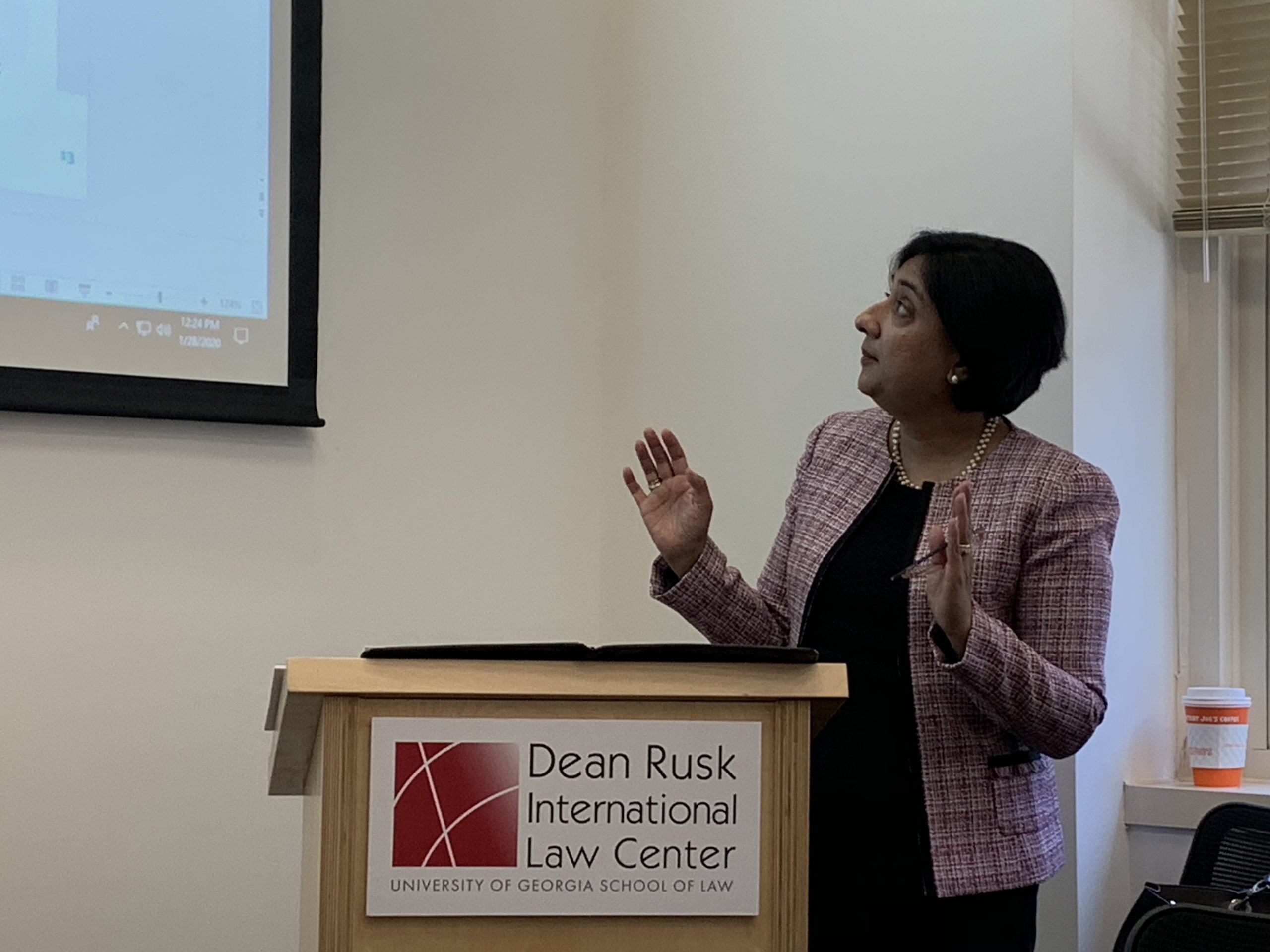
It’s national ranking by US News is #27 in National Law Schools. Students can spend a school break abroad through the Georgia Law-Leuven Global Governance Summer School in Belgium or through a global externship or public interest fellowship.
The Dean Rusk International Law Center of the School of Law is a hub for international law research, externship placements and global outreach projects.
The Rusk Center’s LL.M.s include judges and law firm partners, leaders in governments and in intergovernmental and non-governmental organizations, CEOs and heads of corporate legal departments, and university professors and administrators.
Your suggestions for books and movies which all students should read and watch?
I recently watched “Little Women” based on the book by Louisa May Alcott with my mother and daughters.
It made me appreciate that we live in a time when women have greater legal rights and protections and the option to choose a variety of careers, than before!
Parting advice for our readers.
Recently, I read the following saying of Doug Ivestor, former CEO and Chairman of Coca Cola, at the new state of the art UGA Terry College of Business Learning Center, which I find inspirational:
Never let your memories be greater than your dreams.




. Discussions include LLM Application and Practice in U.S)